
MUNICON 2025: Five Herrera Speakers Present Across Seven Sessions
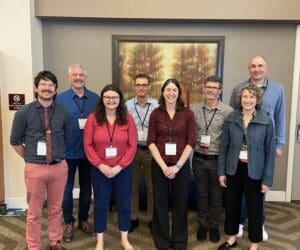
Herrera was proud to sponsor MuniCon 2025, held in the City of Vancouver, WA. Eight members of Herrera’s water practice attended MuniCon 2025, and five of Herrera’s experts presented across seven sessions during the conference.

Dylan Ahearn Presents on Regional Bioretention Innovation
At MuniCon 2025, Herrera’s Dylan Ahearn, PhD, presented “6PPDQ and PFAS Removal Using Regional Bioretention Systems,” a session focused on two of the most challenging emerging contaminants in stormwater. The case study traced Herrera’s bioretention research and application over more than a decade, from early work in the City of Redmond (2013), through four years of lab-based media studies, to the development of a new high-performance bioretention mix.
The session tied these efforts together by showing the design and construction of Whatcom County’s Geneva Swale retrofit, where the new media is now in use, and its current performance. Early results show the $704K project has already removed 25 pounds of total phosphorus, resolved chronic flooding issues, and reduced 6PPDQ to non-detectable levels.
The presentation highlighted how updated design, regionally tested materials, and inter-agency collaboration can address persistent water quality challenges at scale.

John Lenth Presents on Continuous Monitoring Adaptive Control
John Lenth, Herrera’s previous Water Practice Director and current Chief Strategic Officer, partnered with the City of Redmond to share lessons from a four-year pilot of Continuous Monitoring Adaptive Control (CMAC) in urban stormwater ponds. CMAC technology increases flexibility compared to traditional ponds but adds complexity, requiring careful attention to valve placement, power sources, and maintenance. John and Peter Holte from the City highlighted challenges such as supply chain delays and equipment failures, as well as opportunities to reduce costs with retrofits in built-out areas. Early results show CMAC improves system performance and resilience, offering valuable insights for jurisdictions evaluating smart stormwater retrofits.
Video of the session is available here: Washington Stormwater Center (YouTube)

Rebecca Dugopolski Participates on SMED and CBP3 Panels
Principal Engineer Rebecca Dugopolski shared expertise on two panels: Stormwater Management for Existing Development (SMED) and Community-Based Public-Private Partnerships (CBP3s). On the SMED panel, she highlighted permit requirements for Phase I and Phase II jurisdictions and facilitated an interactive discussion on current SMED implementation to gather ideas for the planning, reporting, and mapping tools that will be developed through a Grant of Regional or Statewide Significance to support MS4 compliance. On the CBP3 panel, she discussed Herrera’s assistance with the Washington State Department of Ecology (Ecology) initiative to spur the development of CBP3s in Washington to accelerate stormwater project delivery. Together, these sessions showcased practical strategies for meeting regulatory goals while advancing collaborative, cost-effective water quality improvements.
Video of the SMED session is available here: Washington Stormwater Center (YouTube)

James Packman Presents on Evaluation of Stormwater BMP Maintenance Standards, and Mobile Business Identification for Stormwater Source Control
James Packman presented on two Stormwater Action Monitoring (SAM) studies. The first evaluated the maintenance standards for selected stormwater best management practices (BMPs) in the Stormwater Management Manual for Western Washington (SWMMWW). While the SWMMWW has been revised several times since its inception in 1992, many of the BMP maintenance standards in Appendix V-A have not been updated. The study examined their history, usage, and differences across western Washington. Pilot data suggest that adjusting the type and frequency of some activities could reduce effort for permittees while promoting additional benefits such as habitat features.
Video of the session is available here: Washington Stormwater Center (YouTube)
The second presentation demonstrated a keyword search tool developed to help municipal NPDES permittees identify mobile businesses relevant to stormwater source control. Built in Python as a Windows executable, the tool uses business license data to simplify identification and can be customized for other business types.
Video of the session is available here: Washington Stormwater Center (YouTube)

Tim Clark Presents on Targeted Treatment for a Toxic Tire Chemical (6PPD-Q) In Clark, alongside Carly Greyell (King County Water and Land Resources Division) shared the tools and studies that are preparing King County (in western Washington State) to address the harmful chemical from tires called 6PPD-quinone (6PPDQ). They focused on answering the questions: 1) Which road segments do we expect to deliver the most 6PPD-q to the stormwater network? and 2) Where should we prioritize treatment? King County and Herrera have developed an expert knowledge-based spatial model that classifies road segments by the relative expected amount of 6PPDQ delivered to the stormwater network. Output from the model will be combined with additional spatial information, like nearby salmon habitat, to prioritize which road segments need treatment first and identify opportunities for multi-benefit projects.
Posted In:
Stormwater, Water