
Working Alongside the Suquamish Tribe to Restore the Point Bolin Shoreline
By Dani Backman
November is Native American Heritage Month, a time to recognize the cultures, histories, traditions, and contributions of Native American and Alaska Native communities. It’s also an opportunity to highlight work being led by the Suquamish Tribe to care for Tribal lands and reflect on the importance of partnership and stewardship in the places where we live and work.
At Point Bolin, where several Tribal allotments are experiencing coastal erosion along low- to moderate-bank shorelines, our team is working alongside the Tribal government and neighboring property owners to understand the conditions contributing to erosion and develop restoration improvements that respond to the site as a connected system.
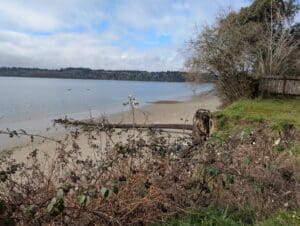
Erosion hotspot on one property filled with trash and yard waste, area planned for cleanup and increased native vegetation.
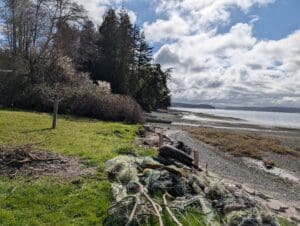
Low bank with modern garbage embedded in slope, area planned for waste removal, regrading, and increased native vegetation.
Understanding the shoreline as a whole
Coastal erosion can be influenced by conditions both along the shoreline and farther upland. At Point Bolin, Herrera is evaluating shoreline, hydrogeologic, stormwater drainage, and ecological conditions that may be contributing to ongoing erosion.
Herrera’s multidisciplinary approach to restoration at this site incorporates hydrogeologic, coastal geomorphic, stormwater, wetland, stream, cultural resources, and land survey investigations to develop a high-level concept design.
Herrera also worked with local archaeologists to document the presence and locations of culturally significant resources and conducted critical areas reconnaissance. These investigations inform design documentation for drainage, shoreline, and stream restoration improvements.
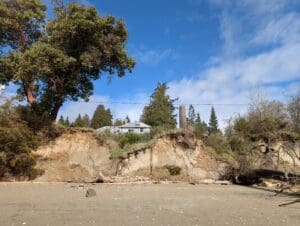
Bluff exhibiting sagging along crest from improper stormwater management in the uplands.
Designing for connected outcomes
The Point Bolin improvements are being developed with several goals in mind: minimizing upland impacts on coastal erosion, removing modern garbage, improving water quality, and enhancing ecological conditions.
U.S. Environmental Protection Agency (EPA) grant funding is supporting development of the design documentation through the 90 percent design stage. The goal is to equip the Suquamish Tribal government with the design information needed to pursue permitting and construction funding to implement the project.
Partnership at the center
Herrera is grateful for the opportunity to contribute technical expertise to that effort and work alongside the Tribal government toward the next stage of restoration.
Learn more about the Suquamish Tribe.
Posted In:
Climate, Coastal, News, Restoration, Tribes, Washington