
Measuring Watershed-Scale Change
By Dani Backman
For years, stormwater research has focused on individual sites and parcels. Less has been known about how those efforts add up across an entire watershed.
Herrera partnered with the City of Redmond Public Works Department to help close that gap through the 10-year Redmond Paired Watershed Study. With the study nearing completion, it offers one of the most comprehensive looks to date at how watershed rehabilitation can influence receiving water conditions over time.

Watershed prioritized for different levels of rehabilitation in City of Redmond
Building a foundation for long-term insight
The study began by grounding the work in existing knowledge. Herrera conducted a literature review of 123 references and compiled an annotated bibliography to identify meaningful indicators of long-term stream health.
This step helped shape a monitoring approach that reflects both past research and the specific conditions of Redmond’s watersheds. It ensured the study focused on metrics that could demonstrate change over time, not just snapshots.
Designing for statistical confidence
A key challenge in long-term environmental monitoring is detecting real trends within naturally variable systems. To address this, Herrera developed a custom Monte Carlo simulation tool to test the statistical power of the study design.
The tool evaluated how factors like sample size, variability, trend magnitude, and significance level influence the ability to detect change. This approach strengthened the study’s foundation and supported confidence in the results over the full monitoring period.
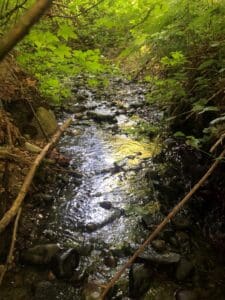
Tosh Creek, an Application Watershed in the City of Redmond
Leadership and partnership in practice
As Herrera’s project manager, Principal Scientist John Lenth led this project and guided its day-to-day coordination with the City of Redmond, while Dylan Ahearn, Ph.D., provided senior technical oversight as Principal in Charge. Together, along with an interdisciplinary team, they supported a study that balanced scientific rigor with practical implementation. The partnership with the City of Redmond was steady and collaborative throughout the full study period, creating space for shared problem solving, clear communication, and a consistent commitment to improving watershed health.
Over the years, many Herrera staff made this project happen, collecting data and sampling on short notice (cued by storm events), oftentimes in the rain on nights and weekends to collect the data needed. We are so grateful for our field team!
Monitoring across diverse watershed conditions
The study monitored seven watersheds with distinct roles in experimental design. Three watersheds were prioritized for rehabilitation, two served as relatively undisturbed references, and two reflected heavily urbanized conditions.
Across all sites, the team collected data on water quality, sediment quality, flow, physical habitat, and benthic macroinvertebrates. These indicators provided a comprehensive view of watershed function and response.
Benthic Index of Biotic Integrity, or BIBI, scores played a central role in assessing stream health. By tracking these biological indicators alongside physical and chemical data, the study connected watershed changes to ecological outcomes.
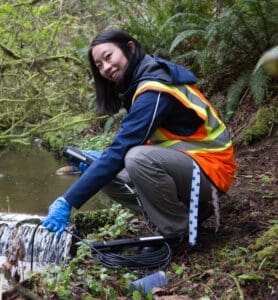
Routine water quality monitoring for the Redmond Paired Watershed Study
Collaborative learning at a regional scale
Given the study’s significance, Herrera and the City of Redmond convened a technical advisory committee with representatives from the Washington State Department of Ecology, U.S. Environmental Protection Agency, U.S. Geological Survey, Kitsap County, King County, City of Redmond, City of Tacoma, City of Kirkland, and City of Seattle.
This collaboration supported shared learning and ensured the study aligned with regional and national priorities for stormwater management and water quality.
Reflecting on a decade of monitoring
The Redmond Paired Watershed Study contributes to a growing understanding of how watershed-scale investments influence long-term environmental outcomes. It builds a bridge between site-level practices and broader system performance.
At Herrera, this work reflects commitment to science-informed decision-making and collaborative problem solving. As communities continue to invest in watershed health, we will keep sharing what we learn and applying it to future projects that support resilient water systems.
Posted In:
Environmental, Research, Seattle, Water, Water Quality