
Rethreading Ecological and Cultural Resilience into the Puyallup River Basin
By Dani Backman
What does it take to restore a river system in a way that strengthens both ecological function and cultural connection?
In early February, Herrera joined partners, practitioners, and community leaders at River Restoration Northwest’s 2026 Symposium to explore that question. Held at the Skamania Lodge, the annual gathering brings together people working across science, engineering, planning, and policy to advance river restoration throughout the region.
At this year’s symposium, Herrera landscape architect Kate Forester presented insights from the SR 167 Riparian Restoration Program, a multi-year effort designed to restore over 275 acres of habitat while centering climate resilience, riparian processes, and ethnobotany. Her talk highlighted how the program reconnects streams, rebuilds floodplain function, and supports culturally significant plant communities.
Creating a Connected Riparian Corridor
The SR 167 Riparian Restoration Program focuses on establishing a continuous corridor of restored streams, wetlands, floodplain areas, and buffers. Her talk illustrated the program’s staged approach, including new stream channels, wetland enhancements, and floodplain reconnection across locations such as Upper and Lower Hylebos, the Surprise Lake Tributary, and Wapato Creek.
The large scale of this project created opportunities to integrate a diverse mix of habitat features that serve fish, amphibians, birds, and other wildlife.
Prioritizing Climate Resilience and Cultural Planting Design
Much of Kate’s presentation centered on the program’s planting strategy, which emphasizes species diversity, climate adaptive plant communities, and cultural significance.
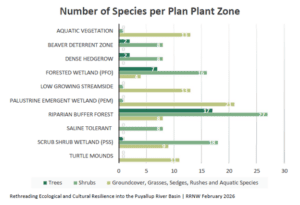
One of the climate resilience strategies for the project included incorporating a high degree of species diversity. Plants are also required to be grown from seed to ensure genetic diversity. Species selection includes plants that will benefit ecological functions, support wildlife habitat, as well as species that are culturally significant.
Integrating Wildlife Habitat Features
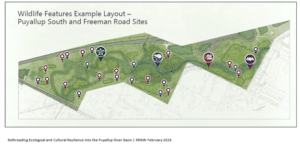
The program also incorporates a wide set of wildlife habitat elements. Examples include:
Floodplain wood structures
• Brush piles
• Turtle nesting mounds and basking logs
• Bat and bird boxes
• Constructed habitat logs and nurse logs
• Perch trees
• Under bridge habitat features
• Beaver analogs
These components provide additional potential uplift for many of the wildlife communities likely to use these restored areas.
Looking Ahead
Participating in the River Restoration Northwest Symposium gave our team the chance to learn alongside others working toward similar goals and to share the lessons emerging from the SR 167 Riparian Restoration Program.
This work reflects a broader shift toward river restoration that honors both ecological integrity and cultural relationships to place. As climate pressures continue to shape the future of the Puyallup River Basin, we remain committed to advancing restoration strategies that support resilient ecosystems and the communities connected to them.
Posted In:
Environmental, Habitat, Landscape Architecture, Natural Areas, News, Presentations, Restoration, Washington