
Seattle’s Coastal Parks: Assessing Habitat and Infrastructure Vulnerability in a Changing Climate
By Dani Backman
From Carkeek, to Alki, to Lincoln Park, Seattle’s coastal parks are beloved access points to Elliott Bay and the greater Puget Sound. They are also where critical public infrastructure meets some of the region’s most productive nearshore ecosystems. Seattle Parks and Recreation (Seattle Parks) is tasked not only with protecting public access, trails and facilities in these community hubs, they are increasingly tasked with safeguarding and stewarding the natural systems that make these places valuable in the first place.
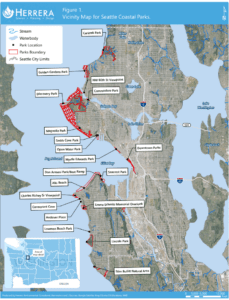
Seattle Parks partnered with Herrera to better understand the vulnerability of these coastal systems and structures to sea level rise, particularly shoreline habitat and critical infrastructure. The project goal was to establish a clear, science-based understanding of how climate change, particularly sea level rise, is likely to affect nearshore habitats, and identify realistic strategies to strengthen their long-term resilience while also considering needed infrastructure upgrades. Our team’s Habitat and Climate Vulnerability Assessment covered nearly 11 miles of coastal parks in Seattle, spanning 19 Puget Sound parks from North Seattle’s Carkeek Park to West Seattle’s Lincoln Park.
Taking an Ecosystems-First Approach
Many climate vulnerability assessments focus primarily on infrastructure. This project shifted the primary focus to nearshore ecosystems, recognizing that beaches, bluffs, eelgrass beds, riparian vegetation, and sediment processes are both foundational and critical to not only a healthy Puget Sound, but to maintaining the very environment that makes these parks simultaneously both urban and wild. Understanding that the existing infrastructure is also highly affected and threatened, our study equally assessed the existing conditions and future susceptibility to anticipated sea level rise.
Herrera conducted field investigations, reviewed and synthesized existing datasets, and completed detailed geospatial analyses to document current ecological conditions. The analysis included shoreline geomorphology, intertidal and subtidal habitats, sediment dynamics, and the condition and elevation of infrastructure relative to projected sea level rise scenarios.
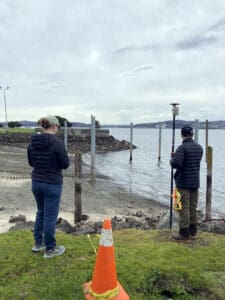
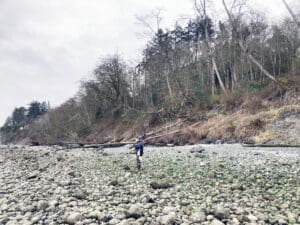
Herrera team conducting field investigations
Assessing Natural Systems in Dense Urban Environments
Seattle’s coastal park shorelines are heavily modified, with widespread shoreline armor, transportation corridors, and a legacy infrastructure that often constrains natural nearshore ecosystem processes.
Despite these constraints, the assessment documented areas of ecological richness and health. Field surveys identified healthy eelgrass beds at several parks, including a notable patch near Alki Beach that is now the subject of an ongoing research collaboration. These findings reinforce the value of pairing rigorous science with on-the-ground observation.
Developing a Resilience Strategy
In addition to establishing a baseline of existing conditions, the assessment identified a range of resilience strategies tailored to Seattle’s coastal parks. These strategies span from programmatic actions that can be taken by Seattle Parks, such as monitoring and stewardship partnership development, to engineered solutions including shoreline restoration, selective armor removal, adaptive infrastructure planning, and protection of high-value habitat areas. We also highlighted areas where additional property protection would enable landward migration of sensitive habitats over time as sea levels rise.
Herrera’s work provides Seattle Parks with a framework to prioritize investments, balance public access with ecological function, and plan for long-term change in a highly dynamic environment.
Supporting Parks Departments Facing Climate Change
As coastal cities confront similar challenges, this project demonstrates how parks departments can integrate climate science, ecology, and infrastructure planning in a practical way to protect the natural and built assets they manage. The project’s resulting framework can be used to highlight and prioritize opportunities to mitigate climate impacts on priority nearshore habitats through nature-based designs, where infrastructure is most at-risk.
For Herrera, the project exemplifies our commitment to helping public agencies navigate climate adaptation in complex, urban settings. Not just by assessing risk, but by connecting science to action.
Posted In:
Coastal, Environmental, Natural Areas, Seattle, Washington