
Listening for Recovery: What Birds Can Tell Us About Mine Reclamation
By Dani Backman
What does success look like after a mine is reclaimed?
For more than two decades, mine site restoration and reclamation have been a core area of expertise for Herrera. Since the early 2000s, our team has supported the Wyoming Department of Environmental Quality (WDEQ) Abandoned Mine Division through the Wyoming Abandoned Mine Land Program (AML) to address environmental and public safety hazards left behind by historic mining practices, reclaiming thousands of acres of abandoned coal, bentonite, and uranium mines across Wyoming.
At Shirley Basin in Carbon County, that work took on a new dimension. The former uranium mill and mine site became a testing ground for an approach that integrates engineering design, ecological restoration, and long‑term monitoring to better understand how reclaimed landscapes function and evolve over time.
Reclamation beyond earthwork
Herrera conducted field investigations and developed a reclamation plan for Shirley Basin. While reshaping landforms and stabilizing soils are foundational to reclamation, they do not fully capture how a site is used once heavy equipment leaves.
To address that gap, AML, Herrera, and project partners incorporated biological indicators into the reclamation process. Bird use was selected as a metric to monitor reclamation success, reflecting the role birds play as sensitive indicators of habitat quality and ecological function, especially in the sagebrush steppe. This monitoring data also informs construction wildlife surveys, which are conducted each season and are essential for maintaining project progress and meeting state and federal clearance requirements.
This approach aligns with a growing body of research showing that reclaimed mine lands can support wildlife when restoration is intentionally designed for ecological outcomes. For example, research in the Appalachian Mountains found that actively restored mine lands can improve broader habitat conditions, including better water quality and increased use by bats and frogs. In contrast, sites left to naturally regrow without targeted restoration efforts often provide little measurable benefit to wildlife, even decades later after. Read more about this research here.
Measuring recovery by sound
At Shirley Basin, AML, Herrera, and project partners deployed SwiftOne autonomous recording units paired with BirdNet software to collect and analyze bird vocalizations. Recorders were placed on reclaimed spoil piles, spoil piles scheduled for future reclamation, and nearby reference sagebrush steppe habitats that were not part of the former mine site.
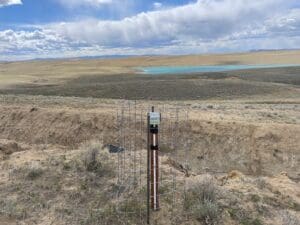
SwiftOne recording unit
By comparing bird vocalization data from spoil piles and reference areas, the team is establishing baseline conditions and will continue evaluating changes over time, including progress toward the desired reference high-quality habitat. Annual comparisons allow Herrera and AML to track bird utilization of post‑reclamation landscapes relative to pre-reclamation conditions, as well as in comparison to high-functioning sagebrush steppe reference habitat.
This offers a practical, measurable, and repeatable way to understand how wildlife, specifically avian species, responds to restored habitats without relying on intensive field surveys alone.
Engineering and biology, working together
This effort reflects the interdisciplinary nature of Herrera’s work. Engineers, scientists, and biologists collaborating to design a reclamation strategy that considers land stability, safety, and ecological function as interconnected goals.
By combining technical reclamation practices with biological monitoring, the project provides insight into how reclaimed mine lands are used by wildlife and how restoration strategies can be refined over time.
A broader signal of hope
Across the West, abandoned mine lands present complex challenges and opportunities. Projects like this one in the Shirley Basin demonstrate how thoughtful reclamation and restoration planning and design can move beyond hazard mitigation toward full functional ecological recovery.
As research continues to show that restored mine sites can contribute to healthy bird communities and functioning ecosystems, Herrera remains committed to applying science‑based, collaborative approaches that create lasting value for landscapes and the people and wildlife that depend on them.
Posted In:
Environmental, Habitat, Natural Areas, Reclamation, Restoration, Wyoming